
Grow Healthy Grass With These Expert Lawn Care Tips
Article Synopsis:
- Applying excessive fertilizer can do more harm than good, leading to turf damage, thatch buildup, and nutrient loss through runoff.
- Lawn feeding delivers the strongest results when paired with healthy maintenance practices like proper irrigation, mowing, and soil analysis.
- Successful fertilization depends more on applying nutrients at the right time than on how often you fertilize.
- Your lawn’s grass variety should guide your fertilization plan, as cool-season turf types like fescue and Kentucky bluegrass benefit most from applications in the late summer and fall.
- Reach out to the lawn care pros at Kapp’s Green Lawn to create a consistently beautiful yard.
What’s the Point of Lawn Fertilizer?
Think of fertilizer as a targeted nutrition program for your grass. Every application delivers three essential elements, each doing a specific job that the others can’t cover.
Nitrogen helps with blade development, shoot density, and the rich color that makes a lawn look genuinely cared for.
Phosphorus operates below the surface, strengthening roots and supporting the energy exchange that keeps grass stable through heat, drought, and heavy use.
Potassium works more quietly than the other two, but it’s what determines whether your lawn can fight off disease and hold its structure when conditions get stressful.
The relationship between fertilizer and results isn’t linear. Beyond a certain point, adding more actually causes damage. It can scorch grass, turning it yellow or brown.
How Many Times Should You Fertilize Per Year?
For most lawns, somewhere between two and four applications annually hits the right balance. Three factors determine exactly where your lawn falls in that range.
Grass variety. Cool-season grasses like tall fescue, Kentucky bluegrass, and perennial ryegrass do the bulk of their growing in fall and early spring, which is where their nutritional demand concentrates.
Soil composition. Sandy or nutrient-poor soils release what they hold quickly, requiring more frequent replenishment to maintain steady availability. Dense, organically rich soil holds nutrients longer and doesn’t need as much between applications.
Fertilizer formulation. Slow-release products meter out nutrients gradually over several weeks, which means fewer applications to maintain consistent feeding. Quick-release formulas deliver results faster but burn through their supply quickly.
Soil Temperature Matters the Most
Grass roots don’t begin absorbing nutrients based on the calendar. They respond to soil temperature.
For cool-season grasses (fescue, Kentucky bluegrass, ryegrass, etc.), the productive feeding range sits between 60 and 75°F. This aligns with their natural growth peaks in fall and early spring.
Warm-season varieties like Bermuda, Zoysia, and St. Augustine operate at higher temperatures, between 70 and 85°F, and want feeding during the warmer months when they’re actively growing.
Checking soil temperature takes less than a minute with an inexpensive probe thermometer. It’s one of those small habits that fundamentally changes how you approach timing.
If you’d rather let the lawn guide you, it will. Two things signal that conditions are right:
- Grass color shifting from the washed-out, flat tones of dormancy to a noticeably deeper, more active green
- Growth rate picking up enough that the lawn actually needs to be mowed
When both of those are happening, the soil is doing what it needs to do. When neither is happening, fertilizer applied to the lawn won’t work as well.
Seasonal Fertilization Schedule
Early Spring: As soil temperatures climb toward 55°F and grass shows signs of waking up, a light application supports root development coming out of dormancy.
Keep it light. Too much nitrogen too early pushes blade growth before roots are ready to support it. Skip if the ground is still frozen or soil temperatures remain below 50°F.
Late Spring: Six to eight weeks after the early spring feeding, this application can support the lawn’s as it really starts to grow.
A nitrogen-focused fertilizer works well here, and many spring blends include a pre-emergent weed control component worth considering if crabgrass or summer weeds are a recurring problem.
Summer: Cool-season grasses struggle in heat. Summer fertilization is about minimal support, not aggressive feeding.
Use slow-release nitrogen to avoid growth surges the lawn cannot sustain. If your lawn goes dormant, skip fertilization entirely until active growth resumes.
Early Fall: If you’re only fertilizing once a year, this is the application to make. Fall feeding builds root systems and nutrient reserves that carry the lawn through winter and fuel spring green-up.
Apply while soil is still warm enough for active uptake.
Late Fall: A second application six to eight weeks after early fall can provide additional root-strengthening benefits. Just be sure that you stop well before the first frost.
Late applications that push blade growth into cold temperatures leave grass vulnerable in winter.
How to Boost Your Fertilization Results
Fertilization doesn’t operate in a vacuum. What you do between applications determines whether the nutrients you put down produce their full effect.
Rethink how you water
Switch to deeper, less frequent watering sessions. This trains roots to grow downward, which expands the soil volume they draw from and makes every fertilizer application work harder without any change in product or rate.
Test your soil
A basic soil test gives you actual data on pH levels, existing nutrient concentrations, and organic matter content. The test costs very little and turns a generic program into one built around what your specific yard is actually missing.
Stop bagging your clippings
Grass cuttings left on the lawn after mowing decompose and cycle nitrogen back into the soil. A mulching mower attachment converts your regular maintenance into a passive, low-level feeding program.
Keep the mower blade height higher
Cutting grass too short removes the leaf surface the plant uses to capture sunlight and produce energy. Taller turf maintains a denser canopy, develops more robust root systems, and puts applied nutrients to better use.
Pay Attention to Your Grass Type
Cool-season grasses
Tall fescue, Kentucky bluegrass, and perennial ryegrass are most active when temperatures are dropping rather than rising. Fall is the single most important feeding window for these varieties. It’s when root systems are expanding most aggressively and the plant is building the energy reserves.
What cool-season grasses don’t need is heavy nitrogen during summer. Fertilizing them during that period pushes growth the plant is physiologically trying to avoid, leaving it weakened and more susceptible to heat stress and disease.
Warm-season grasses
Bermuda, Zoysia, St. Augustine, and centipede grass operate on the opposite schedule entirely. Their productive growing window runs from late spring through early fall. As days shorten and temperatures drop in early fall, feeding frequency should taper off and stop before winter.
Applying nitrogen to warm-season grass late in the season stimulates new blade growth at exactly the wrong moment. The result is a lawn that comes out of winter weaker than it went in.
Tips to Get the Application Right
A few key actions that make a big impact:
- Mow a day or two before you spread anything. Short grass lets the spreader move cleanly across the surface and allows granules to fall through to soil level rather than getting caught on long blades where they sit exposed until the next rain.
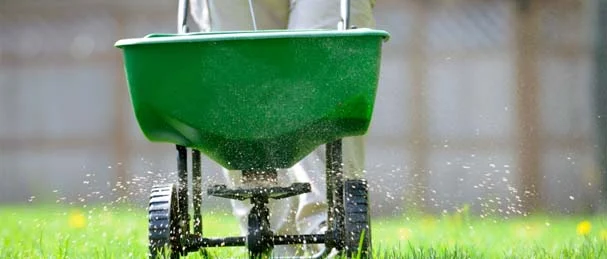
- Match your equipment to the area. Rotary broadcast spreaders cover open lawn efficiently and work well for large, unobstructed areas. Drop spreaders release product in a controlled, narrow band directly below the hopper.
- Walk overlapping passes. Leaving gaps between spreader passes creates nutrient-deficient lanes that show up within days as faint, lighter-colored stripes cutting through an otherwise even lawn.
- Follow up with a light watering. Granules sitting on top of grass blades aren’t doing anything useful.
- Check the forecast before you start. A gentle rain arriving hours after application is fine, but a heavy downpour carries granules off the lawn before the soil absorbs them.
- Clean up hard surfaces immediately. Any granules that land on driveways, walkways, or patios should be swept back onto the lawn before watering.
New or Established Lawn?
A newly established lawn and a mature one have different nutritional needs at different points in the process. Treating them identically produces suboptimal results for both.
Starting from scratch with seed or sod? For seeded areas, work a starter fertilizer into the soil at or just before planting. These formulas are intentionally higher in phosphorus because germinating grass prioritizes root development before almost anything else, and phosphorus is what drives that process.
For sod installations, hold off on fertilizing until the root system has begun knitting into the underlying soil rather than applying immediately after installation.
DO NOT reach for weed control products before the turf is established. Pre-emergent herbicides function by blocking germination at the seed stage, which means they prevent your grass from sprouting just as effectively as they prevent weeds from doing the same. Post-emergent options are less indiscriminate but still place real stress on young, developing turf.
Have an established lawn? The seasonal schedule applies but should be treated as a framework rather than a fixed prescription. Because what the lawn showed you after the last application is useful information.
Typical Lawn Fertilization Mistakes
- Applying fertilizer before the grass is ready. Grass that hasn’t broken dormancy can’t absorb nutrients, so what you’re really doing is giving weeds a head start and increasing the chance of runoff before a single grass root benefits. Soil temperature, not restlessness, should be the trigger.
- Putting down product before a rainstorm. It feels efficient to fertilize ahead of rain, like nature is going to water it in for you. The problem is intensity. A light shower after application is genuinely helpful. A heavy downpour arriving before the soil has absorbed anything carries granules off the lawn entirely.
- Feeding the wrong grass at the wrong point in the season. Cool-season and warm-season grasses operate on opposite schedules, and confusing the two leads to applications that stress the lawn rather than support it..
- Using more product than the situation calls for. Quick-release nitrogen is the most common culprit here. Overapplication causes burn that shows up within days as yellowing or browning across the lawn, and recovery typically takes several weeks.
Lawn Fertilizer FAQs
-
Is it better to fertilize before or after rain?
Light rain after application is ideal. Heavy rain before it soaks in is a problem. So apply on dry grass and water lightly afterward.
-
Should I fertilize if my lawn already looks green?
Looking green doesn’t mean the lawn is well-nourished. Color is one indicator, but growth rate, density, and root depth tell a more complete story.
-
What month is best to fertilize?
For cool-season grasses in the Midwest, September and October are the most important months.
-
Can you fertilize too much?
Yes! Burned grass, excessive thatch buildup, and nutrient runoff can all happen because of overapplication.
Trust the Pros at Kapp’s!
Timing, grass type, product selection, and application rates make a massive difference in how well your lawn fertilization works. Get those factors right, including when to fertilize your lawn, and the grass responds. Miss some steps or misjudge amounts and your results won’t be the best.
Kapp’s Green Lawn is here to help! We proudly serve communities in the Midwest, ensuring high-quality lawn care services in these areas:
- Cleveland, OH
- Fort Wayne, IN
- Indianapolis, IN
- Pittsburgh, PA (eastern)
- Pittsburgh, PA (western)
- St. Louis, MO