Get your lawn back on track with one FREE application!* One FREE Application!* Call Now

How to Get Rid of Ants In 6 Easy Steps

Posted on May 5, 2026

Discover the Best Options for Stopping & Killing Ants

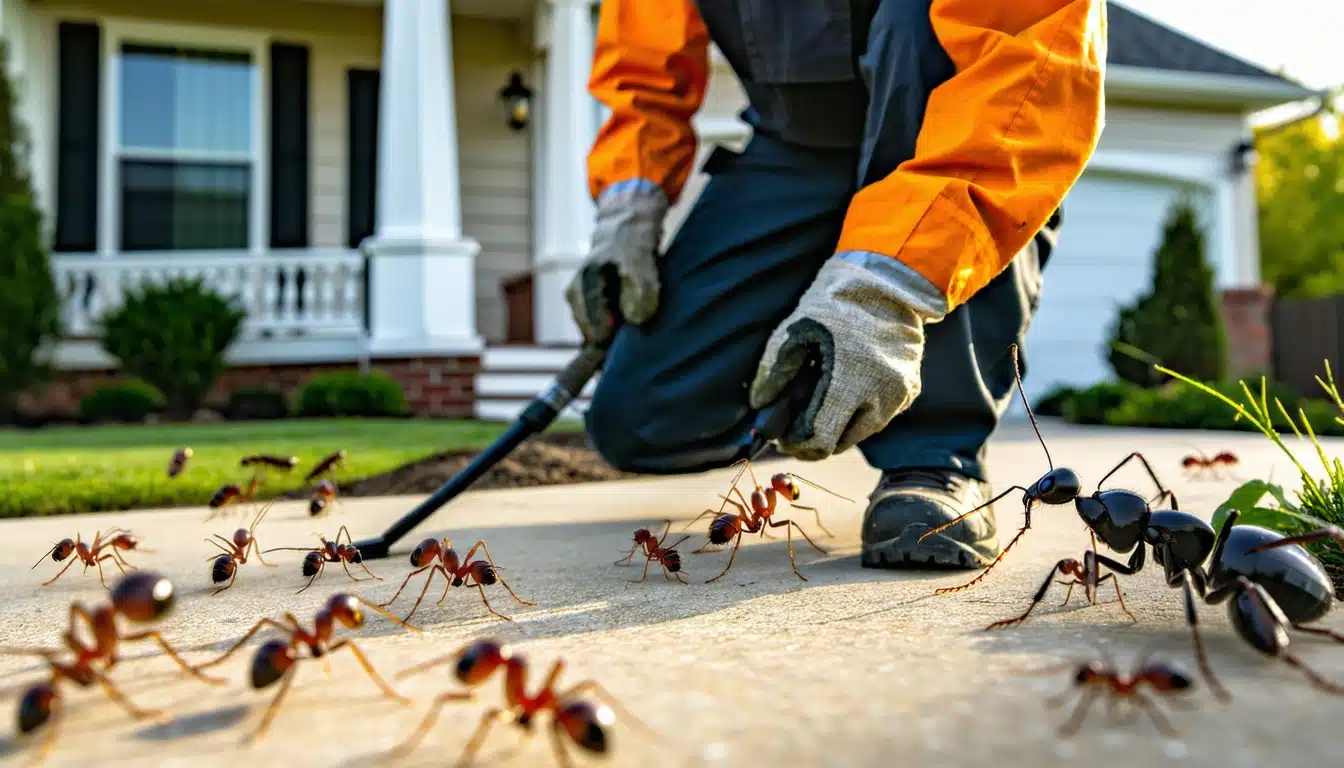
Ants are absolutely maddening. You wipe them up, spray them down, and the trail is right back where it started the next morning. That’s because the ants you see are just a tiny fraction of a much larger operation happening out of sight. Until the colony itself is dealt with, you’re treating symptoms instead of the cause.

The lawn care and pest control team at Kapp’s Green Lawn has put together a practical, step-by-step breakdown of what actually works. Complete eradication is rarely on the table since ants are simply too persistent and too widespread. However, manageable control that lasts is possible. Here’s how to get there.

1. Start by Identifying the Ant Species

There are many kinds of ants in the Midwest. Some are drawn to sugary foods while others go after grease and protein. Some colonies live entirely outdoors, and others establish themselves inside wall voids and stay there. A few species will even split into multiple colonies when they detect a threat. Yikes! 

Ant or something else?

You should also confirm you’re dealing with ants rather than termites. Ants have a clearly segmented body with a pinched waist between the thorax and abdomen. Their antennae bend sharply at an angle. Termites lack that waist entirely and carry straight, bead-like antennae. Why does it matter? Because the treatment approaches are completely different for these two kinds of pests. 

Once you’ve confirmed it’s ants, try to get more specific. Size, color, location, odor, and foraging behavior all provide useful clues. Narrow down the options until there are only a couple of possible species.

How can you tell if you have an infestation? There are several clues for this as well. That includes consistent ant trails running along walls, baseboards, or countertops or regular appearances of ants in your kitchen, bathroom, or pantry.

Outside, mounds close to the foundation or scattered throughout the lawn are indicators. As are small deposits of brownish granular material known as frass. The most obvious clue is a swarm of winged ants. This signals a mature, reproducing colony.

Shrugging your shoulders at these warning signs isn’t a good idea. Carpenter ants hollow out structural wood silently over months and years. Fire ants defend aggressively and can trigger serious reactions. Most species, given undisturbed time and consistent resources, simply keep growing.

Ready to track down the nest? Colony size varies enormously, from a few hundred to hundreds of thousands. The nest itself might be buried underground, hidden beneath a layer of mulch, tucked behind your baseboards, sitting under a concrete slab, or occupying a section of rotting wood somewhere in the yard.

2. Get Rid of Whatever They Like 

Ants don’t stumble into your yard or across your kitchen randomly. They locate food, moisture, or both. Once a viable source is found, the trail forms quickly. Cutting off that supply is an essential early step.

In the kitchen and pantry, tight storage makes a real difference. Move cereals, flour, sugar, and pet food into sealed containers. Wipe down spills before they sit. Stay on top of dishes rather than leaving them stacked overnight. Garbage cans with ill-fitting lids are a surprisingly common entry point that often gets overlooked.

Water draws ants just as reliably as food does. Even a slow, barely-noticeable leak beneath a sink can sustain a colony over the long term. Work through the likely trouble spots (under bathroom and kitchen sinks, around the toilet base, near dishwashers and washing machines) and address whatever you find.

3. Break Up Their Line of Communication

Ants coordinate through pheromone trails: chemical markers deposited along established routes. An active trail grows more defined over time as more workers reinforce it.

Clearing those chemical signals is straightforward. A mixture of equal parts white vinegar and water works well on hard surfaces, as does warm soapy water or a standard glass cleaner. Any of these will strip the pheromone layer and leave returning foragers disoriented.

But don’t mistake trail disruption for a final fix. The colony is still fully intact. Clearing trails prepares the surface for bait placement and makes the treatment steps that follow more effective.

4. Target the Colony, Not Just Individuals  

Reaching for a spray when ants appear is instinctive. The ants die, the trail vanishes, and for a few hours it looks like the problem is gone. Then they come back.

Contact sprays eliminate only the workers they touch. The colony interprets the disruption as a threat and may scatter, sending foragers down alternate routes or fragmenting into satellite groups. You’ve done some damage to the workforce but left the queen completely untouched.

Why bait is the better tool

Bait operates on an entirely different logic. Workers pick it up along active trails, carry it back to the nest, and pass it through the colony via normal feeding behavior. The queen and larvae receive it alongside everyone else. 

Because the active ingredient works slowly, the colony consumes a meaningful dose. Collapse unfolds over a period of days to weeks.

Remember that the formulation you choose has to match what the species is actually eating. Sweet-based liquid baits attract sugar feeders. Protein or grease-based options are necessary for species like carpenter ants. If a bait station is being ignored, that’s almost always a sign that you’ve got the wrong bait rather than a placement issue.

Placement pointers:

  • Position stations directly on or alongside active trails 
  • Don’t apply any repellent spray near bait stations since it’ll drive workers away before they reach it
  • Expect a brief uptick in ant activity after placing bait, which is workers responding to the food source
  • Leave bait accessible for two to four weeks and replenish as needed

5. How to Get Rid of Ants Outdoors 

Treating the inside of your home while ignoring the yard is one of the most common reasons ant control fails to hold. Usually, the colony generating your indoor problem is living outside…and will keep sending workers in.

Where should you look for ants outside?

  • Foundation perimeter and soil directly against the wall
  • Mulch beds, especially where they’re piled against siding
  • Beneath rocks, stepping stones, and landscape timbers
  • Flower pots resting directly on soil
  • Driveway and patio cracks
  • Woodpiles and tree stumps

How to treat ants outside:

Follow foraging trails in reverse to find the nest entrance. Granular bait scattered along foraging paths and around suspected nest sites works well outdoors. For the perimeter itself, non-repellent barrier treatments outperform repellent sprays because ants pass through the treated zone and carry the product back rather than simply routing around it.

Be sure to also pull mulch, vegetation, and debris back from the foundation wall by several inches. This takes away the sheltered, hospitable ground cover ants like and makes it easier to see new activity.

6. Locate Entry Points & Seal Them 

Treating the colony and the perimeter handles the current infestation. Sealing entry points is the step that prevents the cycle from starting again.

Common access points include:

  • Door and window frames, thresholds, and worn weatherstripping
  • Gaps where baseboards meet the floor
  • Pipe and utility line penetrations under sinks and behind appliances
  • Foundation cracks and gaps in siding transitions
  • Crawlspace and soffit vents

Use silicone caulk on gaps and cracks. Swap out deteriorated weatherstripping. Patch any damaged screens. If carpenter ant activity is suspected, probe nearby wood for softness or moisture.

Minimize the landscape features that connect outdoor colonies to your structure. Branches or shrubs making contact with the roofline or siding act as bridges. Firewood stacked against the foundation is an open invitation. Mulch or soil piled against the siding creates exactly the sheltered, moist environment ants prefer to nest in.

Natural Ant Control: What’s Actually Useful?

The natural remedy for ants is a mix of genuinely useful tools and considerably overstated claims. Here’s a breakdown.

Diatomaceous earth (food-grade) works by physically damaging the exoskeleton of any ant that walks through it, leading to dehydration. It’s a reasonable barrier around entry points but loses effectiveness the moment it gets wet. Use it as a supplemental tool, not a primary one.

Vinegar, peppermint oil, and dish soap disrupt trails and kill workers on contact but have no pathway to the colony. They’re useful for surface-level disruption and may discourage scouts near specific entry zones. They won’t solve an established infestation.

Borax-based bait is the natural option with genuine colony-level potential. Mixed at a low concentration with sugar water or peanut butter, it functions similarly to commercial bait products. Just keep it out of reach of children and pets, and remove competing food sources so the bait gets the ants’ full attention.

Is It Possible to Get Rid of Ants Forever? 

Not realistically. Neighboring properties will always have colonies, and environmental conditions regularly help new ones. The honest goal is resilient, long-term control.

Maintaining that control means baiting preventively in early spring before colonies hit peak activity, keeping up with perimeter treatments through the season, staying consistent with sanitation and sealing, and responding quickly when early signs reappear.

How Does Midwest Weather Affect Ants?

Prolonged wet weather saturates soil and pushes colonies toward drier ground, often indoors. Sudden indoor invasions after rain almost always point to an exterior entry point problem. 

Drought has the reverse effect, drawing ants inside in search of moisture, with kitchens and bathrooms bearing the brunt. 

Cold snaps trigger heat-seeking behavior. That’s when sealing and interior baiting become the most effective responses.

When to Involve a Pest Professional

Carpenter ant activity near load-bearing wood or in areas that show signs of moisture damage warrants a professional assessment. Treating the ants without addressing the underlying conditions is only a partial fix.

If the same infestation keeps returning despite consistent effort, or if ants appear to be nesting inside the walls, a pest control professional can identify what the DIY approach has missed. The team at Kapp’s Green Lawn has the tools and the experience to locate the source and shut it down.

More Questions About How to Get Rid of Ants

  • Why do ants keep coming back?

    It’s usually an outdoor colony that was never treated, gaps that were never sealed, or seasonal reinvasion.

  • Do natural remedies work?

    For trail disruption and deterring scouts near entry points, yes. For eliminating an established colony, no.

  • What actually kills the whole colony?

    Slow-acting bait that workers carry back and distribute through the nest. It’s the only method that reliably reaches the queen.

  • Do bait stations attract more ants?

    Temporarily, yes.

  • What's the quickest fix?

    Contact sprays provide fast visible results. Bait combined with exterior perimeter treatment delivers results that actually last.

  • Are ants worse in spring?

    Yes. Emerging from dormancy, colonies send workers out in large numbers almost immediately.

  • How long before bait works?

    Most infestations show meaningful improvement within one to three weeks, depending on colony size.

  • Can ants damage my home?

    Carpenter ants can, over time. 

Trust Your Ant Control to the Midwest Experts

Ants just keep showing up, season after season. But they’re not impossible to manage! Work through the steps and you can have genuine success against ants.

Need help in your fight against ants and other lawn pests? Reach out to Kapp’s Green Lawn! We offer targeted foundation insect spray services designed to keep your home free from common pests like spiders, ants, and centipedes. Our eco-friendly treatments create a protective barrier around your home’s foundation, ensuring long-term protection while prioritizing safety for your plants and pets.

We proudly serve communities in the Midwest, ensuring high-quality lawn care services in these areas: