
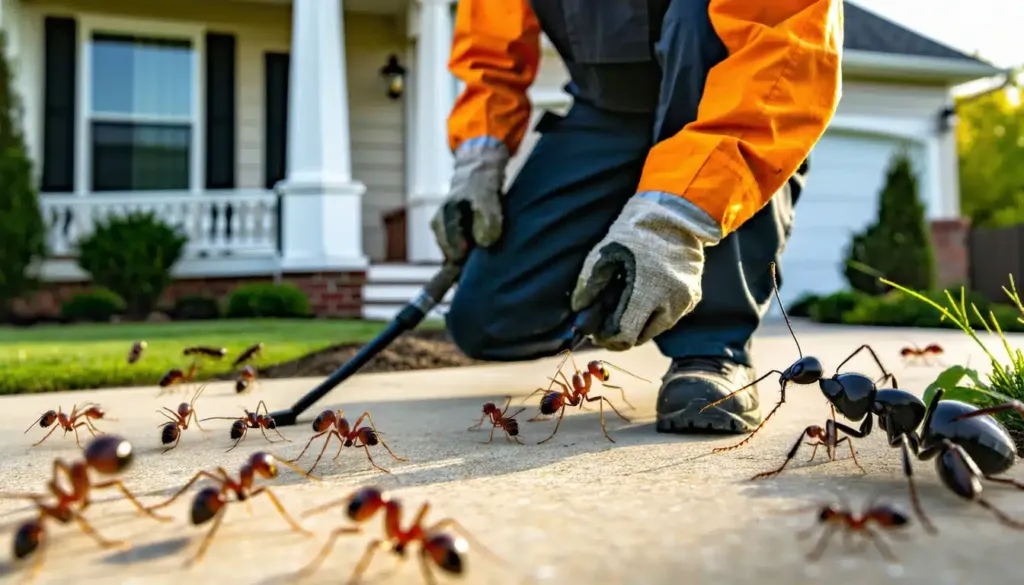
How to Recognize & Stop Different Types of Ants
Posted on March 18, 2026
Some Ants Are Harmless, While Others Should Cause Concern
Noticed a trail of ants marching across your lawn? Spraying them and moving on seems like a good idea. However, different types of ants have distinct preferences for food, areas they like to nest, and levels of threat that they pose.
So the professionals at Kapp’s Green Lawn are sharing ways to recognize typical types of ants, explaining how serious theft can be, and helping you figure out the smartest ant control method.

All About 18 Common Types of Ants
There are thousands of ant species in North America! A much smaller number bothers homeowners in the Midwest. Here’s the inside scoop on the ants you’re most likely to encounter.
Carpenter Ant
- Appearance: Large (1/4 to nearly 1 inch), typically black, and nocturnal.
- Habitat: Excavate galleries in damp or decaying wood and will often maintain satellite colonies indoors connected to a parent nest in a tree or woodpile outside.
- Control: Frass (sawdust-like shavings) near wood is a red flag. Use perimeter baits and non-repellent treatments but also find and treat the parent nest for the most thorough fix.
Little Black Ant / Black Garden Ant
- Appearance: Tiny (about 1/16 inch), jet-black, with a two-segmented waist and no thorax spines.
- Habitat: Nest under rocks, rotting logs, and lumber piles outdoors. Indoors they prefer woodwork, wall voids, and masonry.
- Control: A nuisance, not a structural threat. Seal exterior cracks, keep firewood 20 feet from the house, and trim shrubs away from the foundation.
Pavement Ant
- Appearance: Dark brown to blackish, about 1/8 inch. Found throughout the U.S.
- Habitat: Nest under stones, in pavement cracks, and against foundations. Indoors they trail toward kitchens and bathrooms in search of moisture and food.
- Control: Eliminate standing water, seal foundation cracks, cut back vegetation touching the house, and store firewood away from your home.
Twig Ant
- Appearance: Large, slender, and often bicolored orange and black with oversized eyes (look like wasps).
- Habitat & range: Arboreal, nesting in hollow twigs and branches. They’re most common in Florida, Texas, and other southern states.
- Risk: They sting when disturbed, so be cautious when reaching into shrubs or trees in southern yards.
Sugar Ant
- Appearance: A catch-all term for small (2–15 mm), brown, black, or reddish household ants attracted to sweets — usually pavement, Argentine, or pharaoh ants.
- Habitat: Mostly nocturnal; enter through any gap around doors, windows, or utility penetrations in search of sugary food.
- Control: Sanitation and exclusion first; bait traps along active trails outperform sprays every time.
Acrobat Ant
- Appearance: Light brown to dark brownish-black, about 1/8 inch, with a distinctive heart-shaped abdomen they raise above their head when threatened.
- Habitat & range: Coast-to-coast across the U.S. and indoors since they prefer moist or previously damaged wood.
- Control: An acrobat ant problem is almost always a moisture problem in disguise. Fix the water source first, and the ants follow.
Crazy Ant (Caribbean Crazy Ant)
- Appearance: About 1/8 inch, covered in reddish-brown hairs. These kinds of ants move in a fast, erratic zigzag pattern with no organized trail.
- Habitat & range: Found throughout the U.S. (indoors only in northern states), they surge inside in autumn or after heavy rainfall when outdoor honeydew dries up.
- Control: Multi-queen colonies make sprays largely ineffective. Seal entry points, trim vegetation, and use bait.
Army Ant
- Appearance: About 1/4 inch, dark brown to black with an orange-tinged abdomen and powerful mandibles.
- Habitat & range: Nomadic predators found mainly in Florida, Texas, and the Gulf Coast. They form temporary living colonies (bivouacs) of millions of individuals rather than permanent nests.
- Risk: They don’t infest structures, but a raiding column moving through your yard is worth taking seriously.
Citronella Ant (Yellow Ant)
- Appearance: Workers are 4–5 mm and yellow-to-amber, while winged swarmers are larger and sometimes mistaken for termites.
- Habitat: Subterranean and harmless, nesting in damp areas under slabs, near foundations, and in crawlspaces.
- Control: Late summer swarms look alarming but end quickly, so treatment is rarely necessary.
Fire Ant (Red Imported Fire Ant)
- Appearance: Variable-sized workers that are identified by their raised, dome-shaped mound with no surface exit holes, and are found in open lawns and roadsides across the South.
- Risk: Sting repeatedly with alkaloid venom, causing burning welts. Colonies hold up to 250,000 workers and mass attacks can be life-threatening for allergic individuals.
- Control: Distribute granular bait across the broader treatment area, not just on the mound, for the most effective results.
Moisture Ant
- Appearance: About 1/8 inch, yellowish-to-dark-brown with a translucent abdomen that looks almost wet.
- Habitat: Nest in rotting or water-damaged wood (leaking pipes, crawlspaces, damaged framing) and build mud tunnels between soil and wood.
- Control: These ants are a symptom, not the root cause. Fix the moisture problem first.
Odorous House Ant
- Appearance: Small (1/16–1/8 inch), brown-to-black ants that emit a distinct rotten coconut odor when crushed.
- Habitat: One of the most common indoor ants in the U.S. They nest in wall voids, under sinks, and in moist soil, trailing persistently toward sugary foods.
- Control: Spraying only displaces them. Patient baiting along active trails is the only approach that reliably works.
Field Ant
- Appearance: Large (4–8 mm), often red, black, or bicolored. They build wide, low mounds up to 3–4 feet across in sunny, open areas.
- Habitat & range: Common across North America in lawns, fields, and along fence lines.
- Risk & control: Bite is painful and they spray formic acid. Treat mounds with a labeled granular or drench product.
Pharaoh Ant
- Appearance: Tiny (1.5–2 mm) and nearly transparent, with light yellow to reddish-brown coloring.
- Habitat & risk: Thrive in warm, humid wall voids and hidden spaces. They can carry serious pathogens (staph, strep) and are a significant concern in healthcare settings.
- Control: Their “budding” behavior means sprays cause the colony to split and multiply, so slow-acting bait and professional help are usually the right call.
Thief Ant / Grease Ant
- Appearance: Among the smallest household ants at 1.5–2.2 mm, pale yellowish to light brown.
- Habitat & risk: Prefer greasy, high-protein foods and pose a food contamination risk. They nest in crevices and travel via wall voids.
- Control: Found throughout the U.S., this type of ant is better served with protein/grease-based bait.
Leafcutter Ant (Texas Leaf Cutter)
- Appearance: Reddish-brown workers ranging from 1/16 to 1/2 inch that form columns carrying leaf fragments back to the nest to cultivate fungus.
- Habitat & range: Primarily East Texas, the Rio Grande Valley, and Louisiana. Mature colonies can occupy up to an acre.
- Risk: Can cause significant plant damage, especially to pine seedlings in winter when other food sources are scarce.
Argentine Ant
- Appearance: Light to dark brown, about 1/8 inch. They form massive, fast-moving trails but are found mostly on the West Coast, especially Southern California.
- Habitat: They surge indoors during heat or heavy rain but mainly nest in soil, concrete walls, between boards, and inside structures.
- Control: Ranked among the world’s 100 worst invasive species because spraying stimulates egg-laying and worsens the problem. Patient trail-baiting is the only effective approach.
Ghost Ant
- Appearance: About 1.5 mm with pale legs and abdomen, they emit a coconut-like odor when crushed.
- Habitat: A serious pest in Florida and warm, humid climates. They feed on sweets and appear on kitchen floors and bathroom surfaces, often entering through tiny gaps or on plants.
- Control: Multiple nesting sites with queens regularly splitting off make elimination difficult, so professional-grade baiting is usually necessary.
Helpful Hints for Identifying an Ant in the Midwest
Location. Where you’re seeing ants matters enormously. Mounds in your yard? Trails along pavement? Activity near a woodpile? Those are all clues about the kinds of ants you have.
Appearance. Are they tiny or large? Black, brown, reddish, yellow, or a mix? Heart-shaped abdomen? Wasp-like? How many bumps are between the thorax and abdomen? These are all aspects to look closely at.
Behavior. Ants that march in tight single-file trails are usually organized species like odorous house ants or Argentine ants. Erratic, fast-moving ants that seem to zigzag? That might be the aptly named crazy ant.
Scent. Try crushing one and see what it smells like. The scents of rotten coconut, citrus, or nothing at all provide information, too.
There are other clues as well. Soil mounds in open, sunny areas? Likely fire ants or field ants. Wood shavings (frass) near baseboards or windowsills? That’s a red flag for carpenter ants. Mud tubes or damage in damp wood near a leaking pipe suggest moisture ants.
Eliminating Ants 101
Keep in mind that spraying a line of ants likely only kills the workers you can see. The vast majority of the colony (including the queen and brood) is still in the nest. Plus, spraying some ant species can trigger budding, multiplying your problem.
Consider using baits instead. Workers pick up slow-acting bait and carry it back to the nest, where it spreads through the colony. A little patience goes a long way since bait takes days or weeks to knock out a colony. But the results are more thorough.
For outdoor nests and mounds, granular baits distributed around the treatment area (not just poured on the mound) are highly effective for fire ants and carpenter ants. Perimeter treatments applied along the foundation and entry points help prevent re-entry as well.
4 Practices for Ant Prevention
Lasting ant control involves removing what draws ants to your property in the first place. These four areas address the vast majority of what brings them in:
Moisture control. Dripping faucets and slow pipe leaks create the conditions moisture-loving species seek out. Repair them quickly. Also, make sure gutters stay clear so rainwater moves away from your foundation rather than pooling against it.
Yard and landscape. Pull mulch back so there’s at least a foot of clearance between it and your foundation. Relocate wood piles well away from the exterior walls. Cut back any branches or shrubs making direct contact with the house, and rake up leaf litter that gives colonies a sheltered place to get established.
Exclusion. Walk the perimeter and fill any cracks or openings around the foundation, door frames, and windows using silicone-based caulk. Check that weatherstripping forms a tight seal and that window and door screens are intact with no tears or gaps.
Sanitation. Ants follow food, so cut off the supply. Transfer pantry items into airtight containers, tackle crumbs and grease residue before they accumulate, and make sure trash cans have lids and get emptied on a regular schedule.
Differences Between Regions
Ant pressure varies considerably depending on where you live and what time of year it is. In cooler, wetter parts of the country (Ohio, Indiana, Pennsylvania, and Missouri), carpenter ants and moisture ants tend to dominate. Both are closely linked to the damp conditions and older housing.
In warm southern states (Texas, Florida, and along the Gulf Coast), fire ants are essentially a permanent fixture, with activity ramping up most noticeably in spring and fall. Army ants and twig ants are also primarily a southern issue, and the warm climate stretches the active season for nearly every species.
No matter where you live, fall tends to be the season when ant activity migrates indoors. As outdoor temperatures fall and natural food sources disappear, colonies start looking for warmer options. Remember, any colony that gets established near an indoor heat source may stay active straight through the coldest months.
Answers to Your Ant FAQs
-
What ants cause damage to wood?
Carpenter ants and moisture ants are the two main species associated with wood damage in U.S. homes.
-
What ants smell like coconut when crushed?
Odorous house ants and ghost ants. The rotten-coconut scent is one of the more reliable ways to identify them quickly.
-
Is bait better than spray?
Usually. Sprays eliminate surface workers while the colony carries on undisturbed. Bait gets carried back to the nest and does damage where it counts.
-
How do I find the nest?
Let the ants lead you there. Trace the column back toward its origin, ideally in the evening when many species are most active.
-
What does it mean if I see winged ants?
Called swarmers or alates, these ants are the reproductive members of a mature colony, heading out to mate and establish new ones. Spotting them means there’s a well-developed colony somewhere nearby.
-
What are the most common household ants?
Indoors, odorous house ants, pavement ants, Argentine ants, and little black ants account for the majority of infestations across the country.
-
What's the fastest way to get rid of ants?
Bait is your best tool. Yes, it requires more patience than spraying, but it works on the whole colony, not just the foragers you happen to see.
-
Why do ants come back every year?
Because the conditions that attracted them haven’t been addressed.
DIY or Professional Pest Control?
In minor instances, DIY efforts can work. However, professional ant control makes a big difference in certain situations with ants:
- Large or multiple nests, recurring infestations, or commercial properties
- Possibility of structural impacts
- Persistent activity after proper baiting
- Stinging ants near high-traffic areas
A trained ant control professional can identify the species, locate nests, and apply products and methods not available to the general public.
We proudly serve communities in the Midwest, ensuring high-quality lawn care services in these areas:
- Cleveland, OH
- Fort Wayne, IN
- Indianapolis, IN
- Pittsburgh, PA (eastern)
- Pittsburgh, PA (western)
- St. Louis, MO
Let’s Tackle Your Ant Issue Together
Winning the battle against ants begins long before you reach for any product. It starts with knowing which types of ants you're dealing with, figuring out what's drawing them to your property, and tackling the underlying conditions. For the vast majority of homeowners, that combination of accurate identification, well-placed bait, sealed entry points, and a clean environment will take care of most infestations. Need help in your fight against ants and other lawn pests? Reach out to Kapp’s Green Lawn! We offer targeted foundation insect spray services designed to keep your home free from common pests like spiders, ants, and centipedes. Our eco-friendly treatments create a protective barrier around your home’s foundation, ensuring long-term protection while prioritizing safety for your plants and pets.